|
Raul
Castro: It is essential to overcome old habits and impose
high expectations and rigor as the norm of our daily conduct
HAVANA, Cuba, July 25 (ACN) “
It is essential to overcome old habits and impose high
expectations and rigor as the norm of our daily conduct,”
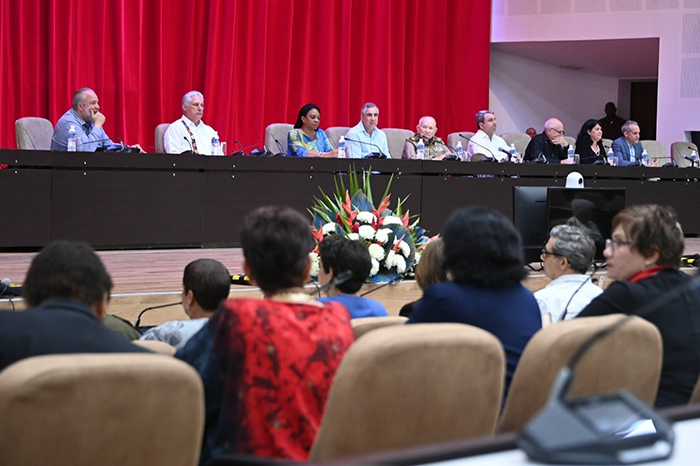
said Cuban President Raul Castro in his closing speech of
the 9th Session of the Cuban National Assembly of People’s
Power (Cuban Parliament), held July 23. ACN now brings you
the full text of the speech in English.
Speech delivered by Army General Raúl Castro
Ruz, First Secretary of the Communist Party
of Cuba Central Committee and President of
the Councils of State and Ministers, during
the closing of the 9th Ordinary Session of
the People’s Power National Assembly, in the
International Convention Center, July 23,
2012, Year 54 of the Revolution.
(Typescript Version–Council of State)
Compañeras and compañeros:
THE last few days have been intense, on
Friday the 20th, we held an important
Council of Ministers meeting, with a number
of invited guests participating, and on
Sunday, the 4th Plenum of the Party’s
Central Committee met.
Since last Thursday, parliamentary
activities have been underway, prior to the
9th Ordinary Period of Sessions of the
National Assembly of People’s Power, during
which deputies received ample information
about the main issues of our current
situation and discussed, in 12 permanent
commissions, extensive agendas which covered
the work undertaken over the course of the
year during visits to workplaces and popular
councils, and participating in local
People’s Power Assemblies, as well as during
everyday interaction with constituents about
our nation’s most pressing problems.
Taking into consideration the
aforementioned, I do not think I need to
make extensive comments and will only
address a few important questions.
Despite the tensions associated with the
global economic and financial crisis, the
effects of the U.S. blockade, along with our
own shortcomings, we can see that the
national economy has performed favorably
during the first half of the year.
The Gross Domestic Product (GDP) grew by
2.1%, a rate two tenths greater than that of
the same period last year, to which a
significant increase in commerce and
construction contributed.
Generally speaking, it was productive
activity which generated economic growth,
although progress in agriculture was modest.
Despite having expanded production of rice,
milk and beans, goals established in plans
were not met. Shortfalls in the production
of pork and citrus fruit limited gains in
this sector.
The sugar harvest, while plagued by delays,
a lack of organization and poor maintenance
in the mills, continued to recover, with
sugar production increasing by 17.1%.
Despite not reaching objectives in income
from tourism, a 5.8% increase in the number
of foreign visitors was achieved and the
sector’s principal indicators improved.
Exports increased in relation to imports,
both in goods and services, which favors the
country’s trade balance and the re-payment
of financial obligations, as part of the
process of restructuring debts with our
principal creditors, thus contributing to
the gradual, but sustained recovery of
Cuba’s economic credibility. Nevertheless,
the tense situation in external financing
continues and is aggravated by restrictions
on the acquisition of new financing.
Domestic financial solvency has been
maintained and supplies of construction
materials for the population have increased,
although insufficiently, in the first half
of the year.
The state budget, as was reported, has been
adequately implemented, leading to the
projection that the year should end with the
deficit not exceeding the approved level.
Abiding by agreements made at the 6th
Congress, the process of implementation of
the Economic and Social Policy Development
Guidelines of the Party and the Revolution
has progressed. While old prohibitions have
been eliminated and additional flexibility
established for the self-employed, the
updating of the economic model has entered a
qualitatively new phase with the drafting
and approval of the 2012-2015 Strategic Plan
for implementation of the Guidelines, with a
corresponding timetable for comprehensive,
step-by-step measures.
At the same time, initial steps were taken
in the conceptualization of the country’s
economic model and the Party and government
leadership has approved policies directed
toward macro-economic reordering in the
areas of credit, retail and wholesale
prices, as well as fiscal policy. The latter
has taken a step forward with the approval,
during this Parliamentary session, of a new
Tax Law.
The fundamental principals for a new
monetary policy have also been studied.
These lay the bases for more substantial
changes in the country’s economic system.
As for the reestablishment of discipline in
domestic finances and the recuperation of
the role of contracts in governing relations
among different economic actors within the
national economy, just as is stated in
Guideline No.10, I can inform you that we
have begun to see the first positive
results, while acknowledging that the road
ahead is a long, laborious one.
This battle, absolutely necessary to
establishing order in the economy, will only
be won with high expectations, rigor and
systematicity on the part of each and every
leader, administrative and enterprise
functionary, with the Party’s continual
supervision.
Additionally, a policy for the experimental
creation of cooperatives in non-agricultural
activities was approved, in accordance with
Guideline No.25. This will lay the basis for
the drafting of a general law governing
cooperatives, after a reasonable period of
experimentation.
Likewise, authorization was given to apply
the formula of renting facilities for
restaurant services, with staffs of up to
five workers, in a manner similar to that
used, at one point, with other personal
service providers such as barbers,
hairdressers and shoe repairmen, to cite
only a few.
This decision, along with the aforementioned
experiments with non-agricultural
cooperatives, will allow the state to
withdraw from the administration of a number
of productive and service activities of a
secondary nature, in order to concentrate on
perfecting the management of the fundamental
means of production, maintained as socialist
state enterprises, which, as is expressed in
Guideline. No.2, are the principal elements
of the national economy.
Toward this end, a group of enterprises has
been selected to carry out an experiment in
which they are granted sufficient autonomy
and ample authority in their economic and
financial management, to establish a new
system of relationships between enterprises
and the state. This experience, of great
complexity and magnitude, will facilitate
the elimination of existing obstacles to the
development of productive forces in the
state sector and the design, and subsequent
approval, of a new law governing socialist
state enterprises.
Likewise, a draft new Labor Code has been
developed, with the goal of adjusting the
rights and responsibilities of workers to
new conditions, taking into account the
incorporation of new non-state forms of
economic management. We plan to present this
draft law to the National Assembly next
June, after it is thoroughly, democratically
discussed with workers and trade unions.
The creation of formulas which promote the
production of food has also been analyzed
within the framework of implementing the
Guidelines. Thus, different measures will be
adopted to eliminate restrictions on the on
the functioning and administration of Basic
Units of Cooperative Production – known as
UBPC – so that all the forms of property
currently existent in Cuban rural areas can
function under the same conditions.
At the same time, in its initial
implementation phase is the policy governing
sales of agricultural products in the
provinces of Havana, Artemisa and Mayabeque,
with the objective of facilitating direct
access to the market for different
productive entities, allowing these to
benefit to a greater degree from sales,
based on the redesign of existing archaic
distribution networks.
Four years after the entering into effect of
Decree-Law 259, which allowed the granting
of idle land in usufruct to producers, and
taking into account the experience gained,
in the next few days a new related
decree-law will be promulgated which will
increase to 67.10 hectares the area of land
which can be awarded in usufruct to those
linked to a state farm, UBPC or Agricultural
Production Cooperative (CPA); authorize the
construction of permanent dwellings by
beneficiaries and assure continuing usufruct
rights to families or other persons who work
the land, among other provisions.
Amidst these changes, the Revolution’s
principle of not leaving anyone unable to
work unprotected has been maintained. Proof
of this are the 110 million pesos in
subsidies awarded individuals to carry out
construction projects on their dwellings.
At the same time, fulfilling Guidelines
No.249 and 250, a set of measures was
designed for the comprehensive solution of
problems affecting Cuban families in
relation to cooking food, starting from the
premise of not modifying the national energy
plan, based on prioritizing electricity for
domestic use which, undoubtedly, is more
rational for the country. These measures
include stabilizing the repair and
maintenance of electrical cooking appliances
and implementing price and credit policies
to cover their replacement or the
acquisition of longer lasting items of
higher quality and improved availability,
including their national production.
In parallel, the experiment to specify the
functions of assemblies and those of
provincial and municipal administrative
councils is ongoing in Artemisa and
Mayabeque provinces, while improvements
continue in relation to the structure of
central state administrative bodies so that
these are focused on state functions which
are their responsibility and do not
interfere in the management of the
enterprise system.
In the context of updating the economic
model, special attention has been given to
the preparation of cadres, 2,500 of them
having graduated with diplomas in Public and
Business Administration.
The implementation of the guidelines also
includes designing the bases for the
country’s economic and social development
program in the long term.
Compañeras and compañeros, in conjunction
with updating the economic model, this is
about leaving behind thinking (solely) about
survival and moving on to projecting – with
rationality, depth and optimism – the
principal lines of development for the
economy’s sustainable development and the
resources and infrastructure required for
that.
You surely must have noticed in the
different reports presented to the Assembly
and in my own address, recurrent mention of
the number of guidelines when aspects
related to these are addressed. I have to
say that this is not by chance, it is fully
intended to firmly establish in our minds a
determination to fulfill these and not to
allow decisions of utmost importance for the
future of our nation to, once again, become
a dead letter.
We must not forget that these agreements are
the fruit of one of the broadest and deepest
democratic exercises the Revolution has
undertaken in consulting the people.
I hold the conviction that you will also
understand that a task of such magnitude
cannot be fulfilled in a climate of
indiscipline, lack of order and impunity. It
is essential to overcome old habits and
impose high expectations and rigor as the
norm of our daily conduct. There is no need
to be inventing anything new, what is
required is, simply, that every day we
demand of ourselves and subordinates the
strict fulfillment of duty in the tasks of
each and every one.
This constitutes one of the principal lines
of my work in the positions of First
Secretary of the Central Committee of the
Party and President of the Councils of State
and Minister, as an essential means of
generating and consolidating the change of
mentality required for fulfilling the
agreements of the 6th Congress and the 1st
National Party Conference.
Nor will we achieve success if we allow
ourselves to be carried away by
improvisation and pressure. Appeals – not
always well-intentioned – to speed up the
rate of changes have not been lacking, both
within the country and from abroad.
In an issue of such significance, on which
the socialist and independent future of the
homeland depends, there will never be space
for siren songs calling us to the immediate
dismantling of socialism and with that,
imposing so-called shock therapies on the
population, or what is the same thing,
endangering the stability of the nation and
the indestructible unity of the people
around the Party and the Revolution.
We shall continue advancing with
decisiveness, serenity and boldness, without
haste, but without pause, and avoiding
committing errors of strategic significance.
In my last two speeches to this Parliament I
addressed the updating of the migration
policy, an issue which has not been in the
least relegated; on the contrary, we have
continued to closely study its gradual
relaxation, taking into account associated
effects and the international scenario.
I confirm today the will of the leadership
of the Party and state to undertake the
reformulation of current regulations in this
sphere and proceed to their gradual
implementation.
In the international order there has also
been fertile activity. I have fresh in my
memory the impressions of the recent
official visits to China and Vietnam, in
which we confirmed the excellent level of
our bilateral links and the disposition to
continue reinforcing them in all areas. The
occasion was also propitious for continuing
exchanges of experience in relation to
building socialism, on the basis of the
characteristics of each country.
We then made a working visit to the Russian
Federation, which allowed us to review the
traditional friendly relations between the
two nations and make new proposals for their
subsequent strengthening.
A few days previously, we attended the
Conference on Climate Change in Rio de
Janeiro, 20 years after the first one, where
the leader of our Revolution, compañero
Fidel, made his resonant speech warning of
the danger of the extinction of the human
race, exposing the causes and contributing
solutions.
On that occasion, we met with Brazilian
President Dilma Rousseff, to whom we
reiterated our satisfaction and pleasure at
the magnificent state of bilateral relations
and their prospects for development, and
addressed the global economic crisis.
It was apparent at the Conference on Climate
Change that next to nothing has been done to
contain it, due to the industrialized
countries’ lack of political will. The
patterns of production and consumption
currently prevailing in these societies are
even more unsustainable, while the
destruction of conditions essential for life
on the planet is accelerating.
At the same time, there is no indication
whatsoever that the profound economic crisis
resulting from egoism and injustice is on
the way to be being resolved. The formulas
implemented by the governments of the
principal economic centers revolve around
the salvation of the privileged classes
while the terrible social consequences are
being borne by workers, the unemployed,
minorities and immigrants.
The fruit of the Revolution’s policy of
principles and its tradition of solidarity
and friendship with the peoples of the
world, our ties with countries on all
continents are being extended and enriched.
Never before has the United States policy of
hostility, economic warfare and subversion
against Cuba been more repudiated. The
reiterated and majority demands of the UN to
end the blockade are joined by the unanimous
position of Latin America and the Caribbean,
expressed with exceptional force and unity
at the so-called Summit of the Americas in
Cartagena, Colombia.
The most recent events in North Africa and
the Middle East demonstrate that the U.S.
government, with the support of the its
European allies, is overtly promoting the
overthrow by force of sovereign governments,
to which end it is arming, financing and
training opposition groups, while still
using mercenaries.
A few days ago, the firm opposition of
Russia and China blocked a UN Security
Council resolution which would have opened
the way to military aggression against
Syria. We have supported, and reaffirm
today, the right of the Syrian people to the
full exercise of self-determination and
sovereignty, without foreign interference or
intervention.
The violence, massacres and acts of
terrorism costing innocent lives, the
transfer of weapons and money to insurgent
groups and media manipulations for political
ends must all stop.
In our region, the United States is
conspiring with national oligarchies against
progressive governments committed to
legitimate demands for social justice and
sovereignty over natural resources. The
recent parliamentary coup d’état in Paraguay
is evidence that this trend will continue,
although new versions of classical military
coups of the past are being added.
Destabilization plots against the Bolivarian
Revolution are constantly being hatched in
relation to the upcoming elections. I will
take advantage of the occasion to proclaim
in the name of the Cuban people our
unshakeable solidarity with and support for
the homeland of Bolívar and our brother,
President Hugo Chávez Frías. (Applause)
There are also conspiracies against Cuba.
The United States is not giving up its
efforts to form a fifth column on our native
soil and in utilizing new technologies for
subversive ends.
The persecution of financial transactions is
growing, as is the dispossession of Cuban
assets, such as the recent case with the
Havana Club label, and propaganda campaigns
against the Revolution are increasing. The
latest example is the disproportionate media
treatment and distortion of the already
controlled cholera outbreak in Granma
province, designed to discredit the Cuban
health system and its achievements,
recognized at the global level.
In accordance with the precepts of the cadre
policy agreed at the 6th Congress and the
1st National Party Conference, beginning
today, a woman who represents the generation
born after the revolutionary triumph, has
been elected Vice President of our
Parliament. I am referring to Ana María Mari
Machado, member of the Central Committee and
a deputy in this Assembly, formerly Vice
President of the People’s Supreme Court.
In this responsibility Ana Maria replaces
Jaime Crombet, who asked to resign for
health reasons and possesses a brilliant
record of service to the Revolution, dating
back to his years as a university student,
first in the Union of University Students
(FEU), the Association of Young Rebels, and
then in the Union of Communist Youth, an
organization through which he rose to the
position of First Secretary of its National
Committee and Chief of the Centenary Youth
Column.
He held important Party positions, as First
Secretary of the Provincial Committee in
Havana and Pinar del Río, representative of
the Party and Cuban ambassador to Angola and
a member of the Central Committee and its
Secretariat. As Chief of the Political
Section of the North Front of Angola, he
took part in actions by this military
command against the interventionist forces
of the dictator Mobutu of what was then the
Republic of Zaire.
In the governmental sphere he was Vice
President of the Council of Ministers.
Considering his outstanding merit, personal
qualities and profound knowledge of the
People's Power system of bodies, compañero
Jaime is to work with me attending the
commission which is to draft the
modifications to be introduced into the
Constitution of the Republic, in fulfillment
of the agreement of the 6th Party Congress.
We are a just a few hours away from the
commemoration in Guantánamo of the 59th
anniversary of the assault on the Moncada
and Carlos Manuel de Céspedes garrisons.
Just like then, there are many challenges
ahead of us, but also the energy and
disposition, in this case of an entire
people, to overcome them, under the
direction of their sole Party, with the same
courage and optimism of our Five Heroes, to
whom we send a warm and fraternal embrace.
That’s all for now.
Thank you very much. (Applause)
|